USDA and DHS Strengthen Response to New World Screwworm
USDA and DHS signed an agreement to strengthen New World screwworm detection, livestock biosecurity, and agricultural threat response.
The U.S. Department of Agriculture (USDA) and Department of Homeland Security (DHS) have entered into a new memorandum of understanding (MOU) aimed at strengthening the federal response to agricultural threats, including New World screwworm (NWS).
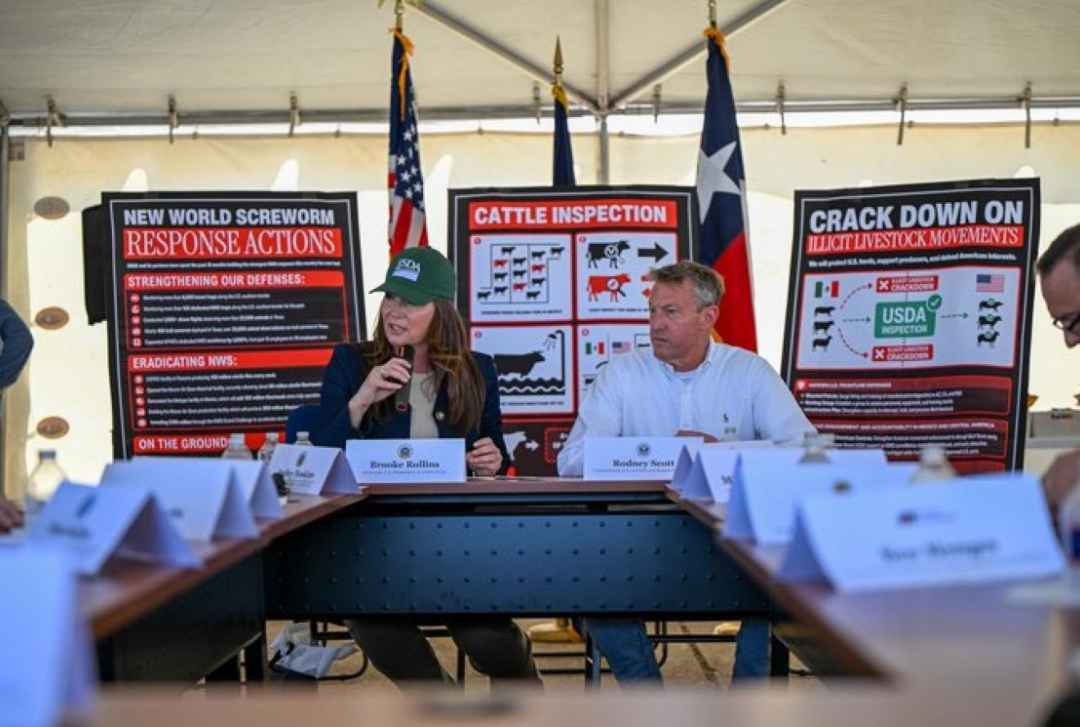
U.S. Secretary of Agriculture Brooke L. Rollins announced the agreement August 10 during an event at Moore Air Base in Texas. U.S. Customs and Border Protection Commissioner Rodney Scott represented U.S. Secretary of Homeland Security Markwayne Mullin.
The agreement builds on USDA’s National Farm Security Action Plan and aligns USDA’s animal health efforts with DHS border, security, and inspection authorities.
“The United States has the strongest food and agriculture system in the world,” said Secretary Rollins. “This new agreement builds upon the National Farm Security Action Plan in partnership with DHS. The MOU further aligns our animal health mission with DHS’s border, security, and inspection authorities, so we are better positioned to detect, assess, and respond to agricultural threats like New World screwworm. Together, we can move faster and more effectively to better support and protect America’s animals, people, and agricultural resources.”
“Safeguarding American agriculture from threats abroad starts at our border,” said Secretary of Homeland Security Markwayne Mullin. “Proud to work alongside Secretary Rollins as we fight to protect our farmers, ranchers, and livestock.”
Focus on Detection and Response
The MOU calls for USDA and DHS to use technologies including unmanned aircraft systems and artificial intelligence to improve screening, detection, and interdiction at and between ports of entry and within border enforcement zones.
The agencies will also share actionable biosurveillance information in real time to support responses ranging from frontline inspections to information exchange. The agreement is intended to improve coordination during high-consequence events involving livestock, wildlife, companion animals, and agricultural resources.
The MOU establishes protocols for coordinated response actions, joint training, and capacity building. It also outlines responsibilities for both departments to help prepare for incidents that threaten the food and agriculture sectors.
USDA and DHS will expand existing research collaborations, including partnerships with DHS Centers of Excellence, to develop screening, detection, and mitigation technologies for NWS and other emerging threats.
Border Biosecurity
The agreement also addresses livestock movement across the U.S.-Mexico border.
According to the USDA, an estimated 800,000 head of cattle are smuggled each year from Central America into Mexico, representing roughly $320 million in illicit trade. Smuggled livestock can bypass sanitary inspection and traceability systems, allowing potentially diseased or unmonitored animals to move across borders.
USDA said the activity threatens regional biosecurity and could jeopardize progress made in eradicating New World screwworm.
The agency will work with Mexico to ensure cattle entering approved U.S. ports of entry are fully documented and legally compliant with USDA import requirements and NWS safeguards.
Ongoing Preparedness
Federal, state, tribal, and local partners, along with industry stakeholders, contributed to the development of the MOU. USDA and DHS will continue refining response tools, strengthening coordination, and supporting joint planning.
The agencies will periodically review and update the agreement to align with evolving preparedness activities and industry practices.
The announcement was made at Moore Air Base, where National Veterinary Services Laboratories' sterile fly production for New World screwworm is ahead of schedule, according to the release.
For farmers and ranchers, the agreement is part of broader federal efforts to detect and respond to animal health threats that could affect livestock and agricultural operations.