Will US Soybeans Be Naughty or Nice?
Market Activity Could Make Soybeans the Season’s Gift — Or Not
The last couple of months were interesting. As we know, the U.S. government was shut down for much of the Northern Hemisphere’s fall quarter (September-October-November), the spring quarter for the Southern Hemisphere (including agricultural giant Brazil and its sidekick Argentina). This allowed a lot to happen in the darkness created by the lights being turned out, including the world’s largest soybean buyer — China — getting more active in the U.S. soybean market.
Government Shutdown, Market Shakeup
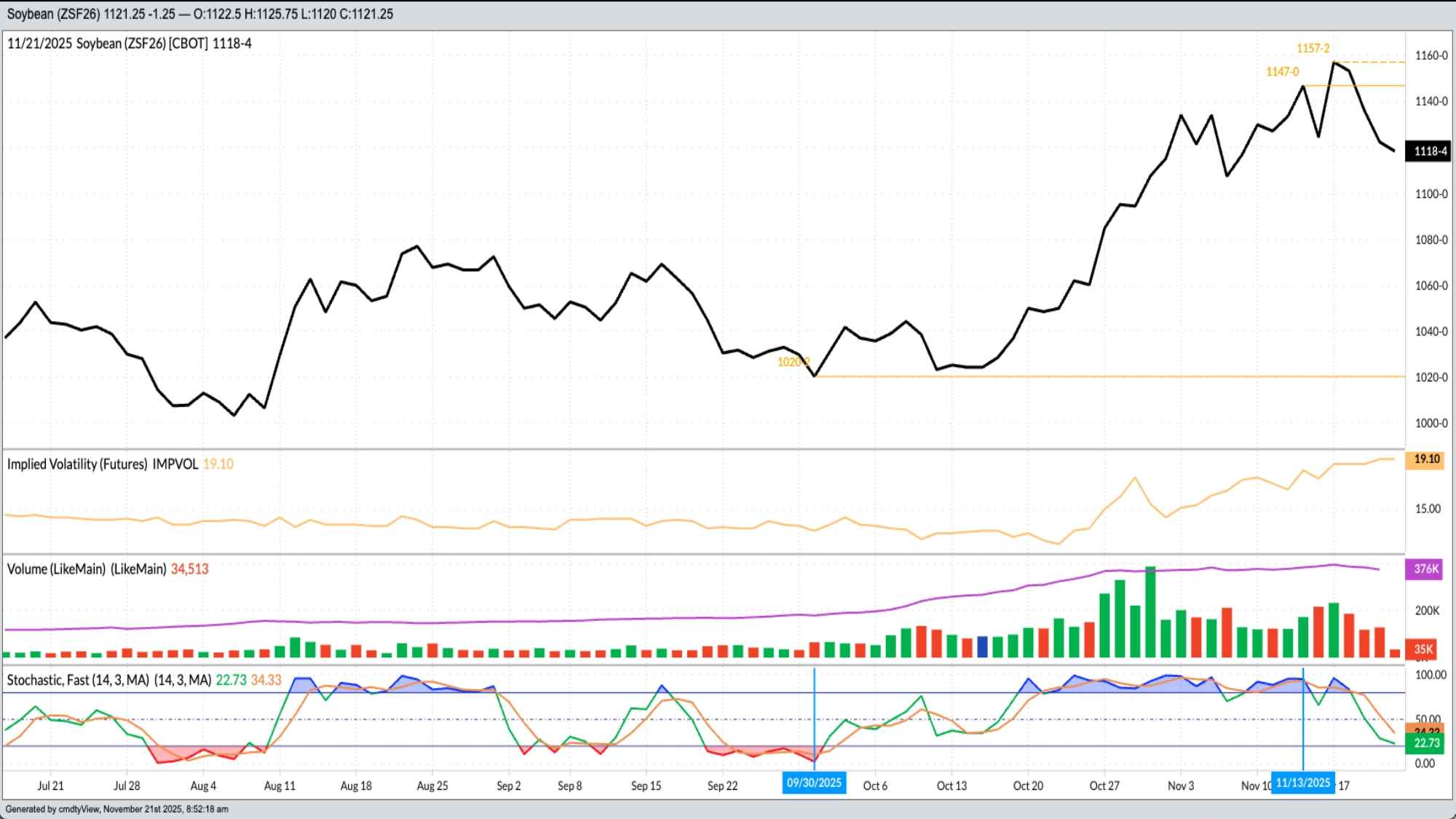
Activity began the moment doors were locked on U.S. government agencies, whose job it is to report such things, starting on October 1. A look at daily closes for the January soybean futures contract shows a low of $10.2025 (per bushel) posted on Tuesday, September 30. Again, that date is important because it was just after midnight on Wednesday, October 1 that the U.S. government ceased to function. (Though many would argue it ceased to function a long time ago.)
This situation remained in place until Thursday, November 13. That day, the January soybean futures contract closed at $11.47, a gain of $1.2650 (12%) over the span of roughly a month and a half. That’s an impressive move. But what caused it?
Tracking the Numbers
Once the wheels of bureaucracy started turning again, albeit as slowly as what we normally see at the DMV, one of the sets of reports I actually pay attention to — weekly export sales and shipments (WESS) — was being released. (My disdain for nearly all government reports, regardless of market sector, is well known.) A quick reminder that WESS is released on Thursdays, usually, and is for sales and shipments made the week ending the previous Thursday.
The first release after the lights were turned back on occurred on November 13 for business the week ending September 25, or just as things were about to come to a screeching halt. At that time, the U.S. had shipped a total of 81 million bushels (mb) during the 2025 to 2026 marketing year (running from September through the following August, another concept I don’t agree with), and had unshipped sales of 356 mb, putting total sales for the first month of the marketing year at 437 mb.
Some food for thought with those numbers: The shipment pace through the first month of the marketing year projected total export demand of 1.35 billion bushels (bb), down 27% from the reported shipments the previous year of 1.841 bb. The first month's total sales number was down 37% from the previous year’s 694 mb for the same week. As for the world’s largest buyer of soybeans — China, again — there were no sales on the books for either the 2025 to 2026 or 2026 to 2027 marketing years.
Digging through the archives, back to the same week a year ago, I found China had 259 mb on the books for the 2024 to 2025 marketing year. Gee, I wonder what changed as the U.S. got deeper into the marketing year, say beyond the first week of November...
Back to 2025: Given what was seen staring on October 1, I watched with interest when the next set of WESS numbers were released on November 20 for the week ending Thursday, October 2. Part of me expected to see China had booked some U.S. soybeans under the cover of darkness, but it wasn’t to be. The latest update again showed nothing. No sales. No shipments. This meant we would have to wait another week. Or maybe longer.
China’s Silent Hand
This is where the market gets even more interesting. The latest “deal” drawn up between the U.S. and China in the trade war that has been ongoing since January 2018 concluded with a great deal of fanfare and boastful statements from the U.S. side. (Though this time, at least the U.S. president didn’t tell producers they would have to work overtime to fill all the demand coming from China.) However, there were again a couple of interesting caveats that took some of the lustre from the bluster. First, as usual, China could buy from the most competitively priced market, with no requirements for purchasing U.S. supplies. Second, China could fulfill its end of the “deal” by buying futures contracts rather than physical bushels of U.S. soybeans. What a great “deal”, right?
Let’s go back to the daily chart for the January futures contract. On September 30, the January issue showed open interest of 179,390 contracts. Through November 13, that number had grown to 384,535 contracts, an 11% increase, meaning open interest more than doubled. Given the data we have on hand as of this writing (late November 2025), all indications are that Chinese interests were buying soybean futures contracts rather than physical U.S. supplies, just as the “deal” allowed, doing the U.S. industry little to no good. But, that being said, we need to continue to monitor WESS, as it is possible, even likely, that cash sales to China will start appearing.
Seasonality and Supply Squeeze
What makes me say that? First, the seasonality of the global market. Given it is springtime in South America, China’s main supplier — Brazil — is likely starting to run tight on supplies until the next harvest comes around in February and March (possibly as early as January). Seasonally, this is when China covers some of its secondary supply needs, and the U.S. has just refilled its bins with the latest harvest.
However, this time around the calendar, U.S. soybeans at the Port of New Orleans are higher priced than those at Brazilian ports, making Brazil still the more competitive market. Therefore, if Chinese merchandisers were buying futures as hedges, once new purchases were made of Brazilian (or Argentine) soybeans, those futures contracts would be sold again.
Lastly, late November did see some announced sales of U.S. soybeans to China. The third week alone saw daily announcements totaling 58 mb. For comparison, by the end of November 2024, China still had 137.5 mb of U.S. soybeans on the books.